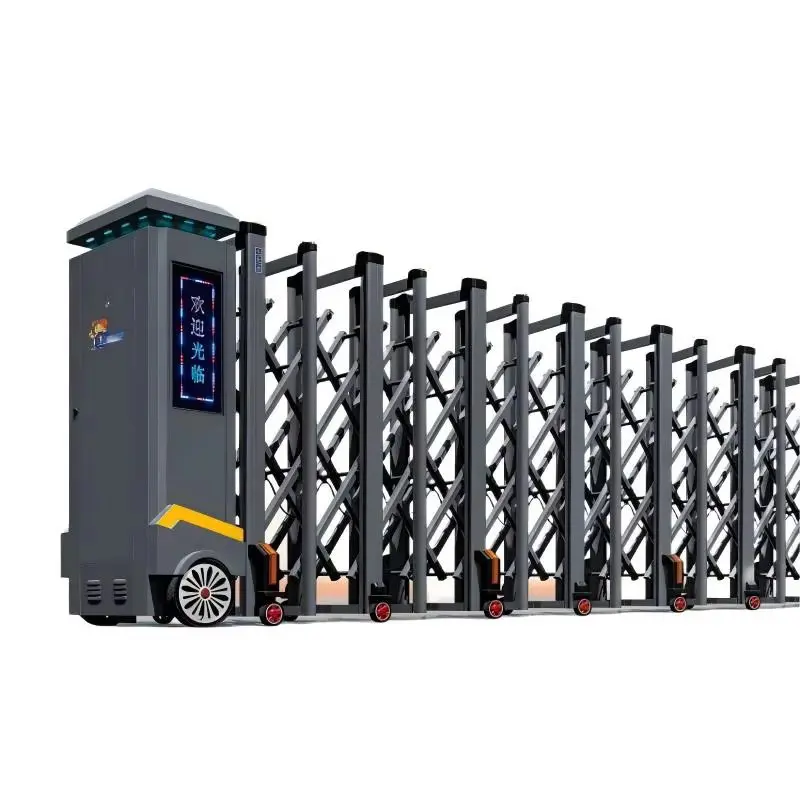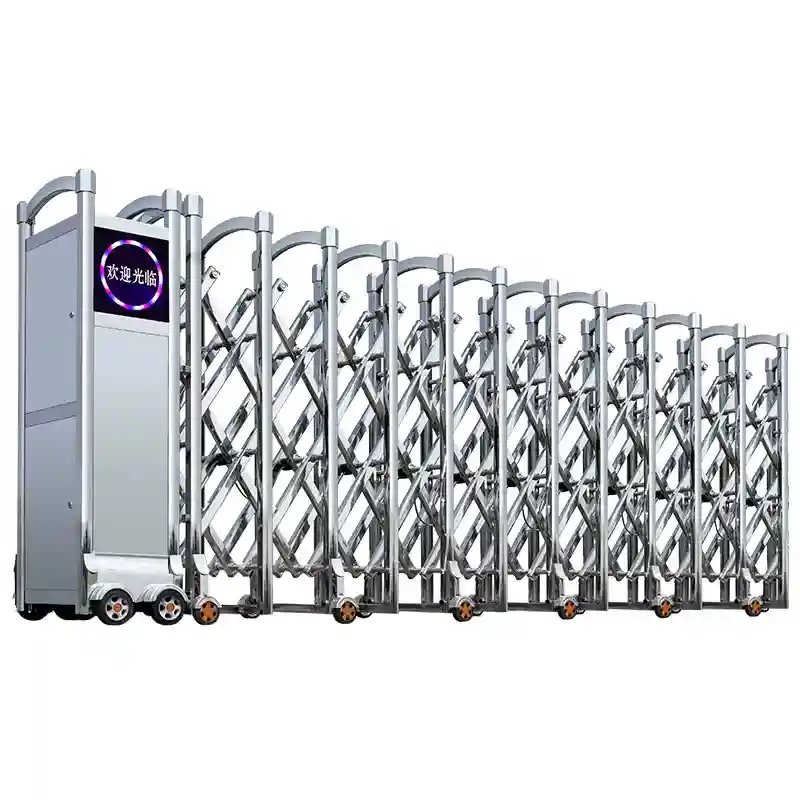
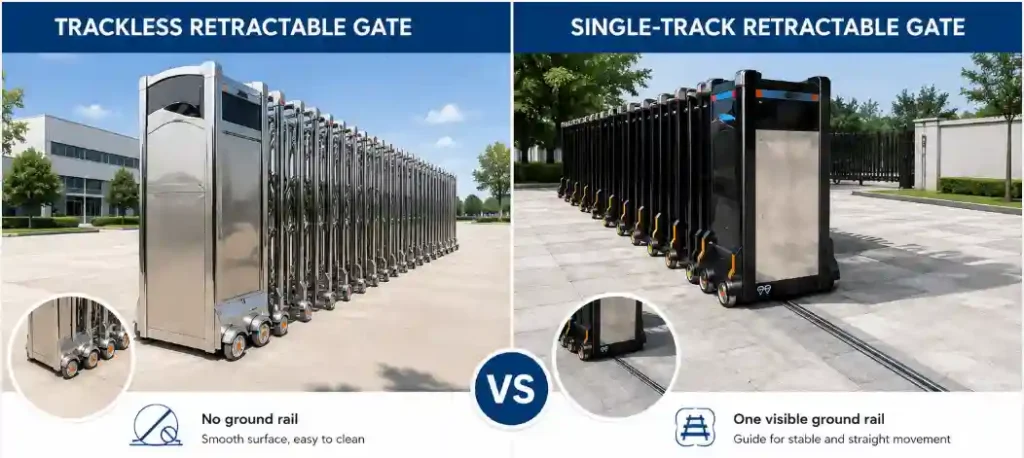
Choosing between a trackless retractable gate and a single-track retractable gate is not simply a matter of appearance.
The two systems use very different guidance methods.
A single-track retractable gate follows a physical rail installed on the ground, while a trackless retractable gate normally relies on sensors, magnetic guidance, or an automatic correction system to maintain its travel direction.
Both solutions can work well.
The better choice depends on your entrance width, pavement condition, traffic frequency, maintenance requirements, installation environment, and budget.
If you are planning an automatic retractable gate for a factory, industrial park, school, residential community, commercial property, warehouse, government facility, or logistics entrance, this guide will help you decide which system is more suitable.
Quick Answer: Trackless or Single-Track Retractable Gate?
For most buyers, the decision can be simplified like this:
Choose a single-track retractable gate if you want a simple, stable, and cost-effective system and installing a ground rail is acceptable.
Choose a trackless retractable gate if appearance, smooth pavement, vehicle access, and reduced exposed ground infrastructure are more important.
However, entrance width and operating conditions also matter.
For very wide openings, heavy gate bodies, demanding wind conditions, or entrances where maximum directional stability is required, a track-guided system may sometimes be the safer choice.
What Is a Single-Track Retractable Gate?
A single-track retractable gate uses one metal guide rail installed along the gate’s travel path.
The bottom guide wheels of the gate follow this rail when the gate opens or closes.
In simple terms:
The rail physically determines where the gate goes.
Because the travel direction is mechanically controlled, single-track systems have traditionally been popular for factories, warehouses, industrial entrances, and other locations where operational stability is a priority.
How Does a Single-Track Retractable Gate Work?
The basic operating process is straightforward:
Motor → drive wheels → ground rail → straight gate movement
The motor moves the gate forward or backward while the wheel-and-rail system keeps the gate aligned.
This mechanical guidance means the control system does not need to continuously correct the direction as aggressively as many trackless systems.
What Is a Trackless Retractable Gate?
A trackless retractable gate, also called a trackless automatic retractable gate or trackless telescopic gate, does not use an exposed steel rail along the driveway.
Instead, the gate uses a guidance and correction system to maintain straight movement.
Depending on the gate design, this may include:
- magnetic navigation
- underground magnets
- magnetic sensors
- electronic direction sensors
- dual-motor correction
- geomagnetic navigation
- intelligent control systems
Magnetic-sensor-based retractable gates are already used to allow operation without conventional pre-embedded surface tracks.
Some more advanced designs can use geomagnetic sensing and electronic correction to control left and right motors independently and correct the gate’s direction automatically.
Trackless vs Single-Track Retractable Gates: Main Differences
| Comparison | Single-Track Retractable Gate | Trackless Retractable Gate |
|---|---|---|
| Guidance method | Physical ground rail | Sensor / magnetic / electronic guidance |
| Visible rail | Yes | No exposed rail |
| Ground appearance | Rail is visible | Cleaner and more seamless |
| Driving comfort | Vehicles cross the rail | Smoother vehicle passage |
| Installation | Rail installation required | Navigation system installation required |
| Directional stability | Very high | Depends on navigation system and commissioning |
| Maintenance | Rail requires cleaning and inspection | Sensors and guidance system require inspection |
| Dust / debris sensitivity | Rail may collect dirt or debris | No exposed rail to collect debris |
| Pavement aesthetics | Less seamless | Better |
| Initial system complexity | Lower | Higher |
| Control technology | Relatively simple | More intelligent |
| Typical cost | Usually lower | Usually higher |
| Best for | Industrial and budget-focused projects | Modern commercial and premium entrances |
1. Installation Method
Installation is one of the biggest differences between the two systems.
Single-Track Gate Installation
A single-track retractable gate normally requires a straight guide rail to be installed along the driveway.
Depending on the site, the installer may need to:
- mark the travel line
- cut or prepare the pavement
- install the rail
- level the rail
- anchor it securely
- restore the surrounding pavement
The accuracy of the rail is important.
If the track is uneven, loose, damaged, or poorly aligned, gate movement may become noisy or unstable.
Trackless Gate Installation
A trackless retractable gate eliminates the long exposed guide rail.
However, trackless does not always mean completely excavation-free.
For magnetic-navigation systems, small magnets or navigation components may still need to be installed below or inside the pavement.
For example, some magnetic-guidance installations place navigation magnets along the gate’s centerline so that the sensor can continuously identify the correct route.
2. Appearance and Pavement Finish
For architectural entrances, this difference can be very noticeable.
A single-track system leaves a metal guide rail visible across the driveway.
For factories, this may not be a problem.
But for:
- office buildings
- residential developments
- hotels
- schools
- government facilities
- modern commercial properties
the exposed track may affect the visual continuity of the pavement.
Trackless retractable gates provide a cleaner entrance because there is no continuous surface rail.
That is one reason trackless systems are frequently chosen for projects where aesthetics are important.
3. Vehicle Traffic
This is one of the strongest reasons to consider a trackless system.
At entrances with frequent:
- cars
- vans
- forklifts
- buses
- delivery vehicles
- trucks
a continuous ground rail becomes part of the vehicle crossing surface.
This does not automatically make a single-track gate unsuitable, but the rail needs to be installed correctly and maintained properly.
A trackless system provides a more continuous driving surface.
Quick recommendation
High vehicle traffic + clean driveway requirement → Trackless gate
Moderate traffic + industrial entrance + budget priority → Single-track gate
4. Stability and Gate Alignment
This is where single-track gates have a natural advantage.
Because the rail physically determines the travel direction, the gate has a strong mechanical reference.
This can be useful for:
- long gates
- heavier retractable gates
- industrial entrances
- sites exposed to wind
- demanding operating environments
Trackless systems rely much more on proper sensor positioning, control logic, gate alignment, motor synchronization, and commissioning.
Modern trackless systems can automatically correct their direction through left/right motor control, but the quality of the navigation system becomes very important.
5. Maintenance
Single-Track Gate Maintenance
Common maintenance points include:
- cleaning dirt from the rail
- removing stones or debris
- checking rail alignment
- checking guide wheels
- checking corrosion
- checking anchors and fasteners
Outdoor rails can collect dust, mud, stones, leaves, or other debris.
This is particularly relevant at construction sites, logistics yards, and dusty industrial environments.
Trackless Gate Maintenance
Trackless systems avoid the long exposed rail, but maintenance may involve:
- magnetic sensors
- navigation sensors
- control boards
- motor synchronization
- direction calibration
- guide wheels
- navigation magnets
Therefore:
Trackless gates generally reduce mechanical track maintenance but increase dependence on electronic navigation and correct calibration.
6. Ground Condition
Ground condition is often overlooked when choosing an automatic retractable gate.
Before selecting either system, check the driveway carefully.
Important factors include:
- Pavement flatness
- Ground slope
- Drainage
- Cracks
- Settlement
- Manholes
- Steel plates
- Expansion joints
- Underground reinforcement
- Water accumulation
A badly prepared driveway can affect both trackless and single-track retractable gates.
For some magnetic-navigation systems, underground steel structures or magnetic interference may also affect the guidance system.
Before Choosing Either Gate, Check Your Ground First
A good retractable gate cannot compensate for a badly prepared driveway. Before comparing trackless and single-track systems, evaluate pavement flatness, drainage, underground structures, traffic load, and available gate storage space.
7. Which Is Better for Wide Entrances?
There is no universal maximum width for every retractable gate.
The suitable width depends on:
- Gate model
- Gate height
- Gate material
- Gate body weight
- Motor power
- Wind load
- Guidance system
- Installation environment
- Structural design
As the gate becomes longer, several factors become more important:
- Wind load increases
- Structural deformation becomes more significant
- Motor load increases
- Straight-line accuracy becomes more important
- Gate body stability becomes more critical
For very wide entrances, the gate should be evaluated as an engineering project instead of being selected only according to catalogue width.
8. Which Is Better in Windy Areas?
Wind resistance does not depend only on whether the gate is trackless or single-track.
Important factors include:
- Gate height
- Gate length
- Frame structure
- Stainless steel or aluminum construction
- Gate weight
- Wheel spacing
- Wind exposure
- Motor power
- Guidance system
A single-track gate may gain additional directional stability from the physical rail.
For a trackless gate, structural rigidity, wheelbase, intelligent correction, and motor configuration become more important.
For coastal areas, open industrial sites, or locations exposed to strong winds, it is better to evaluate the project according to actual wind conditions.
9. Trackless vs Single-Track Gate Cost
In many projects, a single-track retractable gate has a lower initial cost.
This is because the guidance system is mechanically simpler.
A trackless retractable gate may require:
- Additional sensors
- Dual motors
- Navigation components
- Control systems
- Calibration
- More complex commissioning
However, purchase price should not be the only consideration.
Compare Total Cost of Ownership
A better way to compare the two systems is:
**Gate price
- Installation
- Civil work
- Maintenance
- Spare parts
- Downtime
- Pavement repair**
A gate with a lower purchase price is not always the lowest-cost solution over its full service life.
10. Which Retractable Gate Should You Choose?
Choose a Single-Track Retractable Gate If:
- Your budget is limited
- The pavement can be modified
- A visible ground rail is acceptable
- Strong mechanical guidance is important
- The entrance is mainly industrial
- Stability is more important than pavement appearance
- Maintenance staff can regularly clean the rail
Choose a Trackless Retractable Gate If:
- You want a cleaner entrance appearance
- Vehicles frequently cross the gate line
- You do not want a continuous exposed rail
- The pavement should remain visually clean
- Intelligent control is preferred
- The project is a residential, commercial, school, office, or government entrance
- The budget allows a more advanced navigation system
Recommended Gate Type by Application
| Application | Recommended System | Main Reason |
|---|---|---|
| Factory entrance | Single-track or trackless | Depends on traffic and budget |
| Logistics center | Trackless | Smooth vehicle passage |
| Warehouse | Single-track | Stable and cost-effective |
| Residential community | Trackless | Cleaner appearance |
| School | Trackless | Smooth pedestrian and vehicle surface |
| Office building | Trackless | Better architectural appearance |
| Government facility | Trackless | Cleaner entrance design |
| Dusty industrial site | Trackless | No long exposed rail |
| Very wide entrance | Project assessment | Stability must be evaluated |
| High-wind location | Project assessment | Wind load is critical |
A Better Way to Choose: Start With the Entrance, Not the Gate
Instead of asking only:
Should I choose a trackless or single-track retractable gate?
A better question is:
What does the entire entrance need to achieve?
Step 1: Identify Who Uses the Entrance
Determine whether the entrance is mainly used by:
- Employees
- Visitors
- Residents
- Trucks
- Delivery vehicles
- Contractors
Step 2: Determine How Access Will Be Controlled
For vehicle access management, the retractable gate can be integrated with:
- License plate recognition
- Parking barrier gates
- RFID systems
- Remote controls
- Access control systems
For pedestrian access, the entrance can include:
- Turnstiles
- Face recognition
- Smart pedestrian gates
- Access control readers
For higher-security entrances, additional equipment may include:
- Automatic bollards
- Road blockers
- Security barriers
Step 3: Choose the Physical Gate System
After evaluating traffic, pavement, security level, wind, opening width, and budget, you can select either:
Trackless retractable gate
or
Single-track retractable gate
This approach creates a more complete and practical entrance control solution.
Frequently Asked Questions
Is a trackless retractable gate completely track-free?
A trackless retractable gate does not use a continuous exposed ground rail. However, some models still use underground magnets, magnetic sensors, or other navigation components.
Which is more stable, trackless or single-track?
A single-track retractable gate has natural mechanical guidance from the ground rail. A trackless gate relies more on sensor accuracy, motor synchronization, structural quality, installation, and control-system calibration.
Which type is easier to maintain?
A trackless system avoids cleaning and maintaining a long exposed rail, while a single-track system uses a simpler mechanical guidance method. Trackless systems may require more attention to sensors and electronic navigation components.
Which is better for factories?
Both systems can be suitable.
Single-track gates are often preferred when budget and mechanical stability are the main priorities.
Trackless gates are often better when trucks frequently cross the entrance or when a cleaner driveway is required.
Which is better for residential communities?
Trackless retractable gates are often preferred because they provide a cleaner pavement appearance and smoother vehicle passage.
Can a trackless retractable gate be used for a wide entrance?
Yes, but the suitable width depends on the gate structure, height, weight, wind load, motor configuration, and navigation system.
Does a single-track retractable gate affect vehicle traffic?
Normally, vehicles can cross a correctly installed single rail. However, entrances with very high vehicle traffic may prefer a trackless system because it provides a smoother and more continuous pavement surface.
Can trackless retractable gates work with license plate recognition?
Yes. Trackless and single-track retractable gates can both be integrated with license plate recognition, access control systems, RFID, remote controls, and other entrance management equipment.
Final Recommendation
There is no universal winner between a trackless and single-track retractable gate.
The best solution depends on your actual project conditions.
Choose a single-track retractable gate when cost, simple mechanical guidance, and operational stability are the main priorities.
Choose a trackless retractable gate when smooth vehicle passage, cleaner pavement, modern appearance, and intelligent navigation are more important.
For large entrances, high traffic volumes, strong wind environments, or unusually long gate bodies, the final configuration should be selected according to the actual entrance width, pavement condition, gate height, traffic frequency, and security requirements.