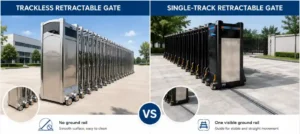
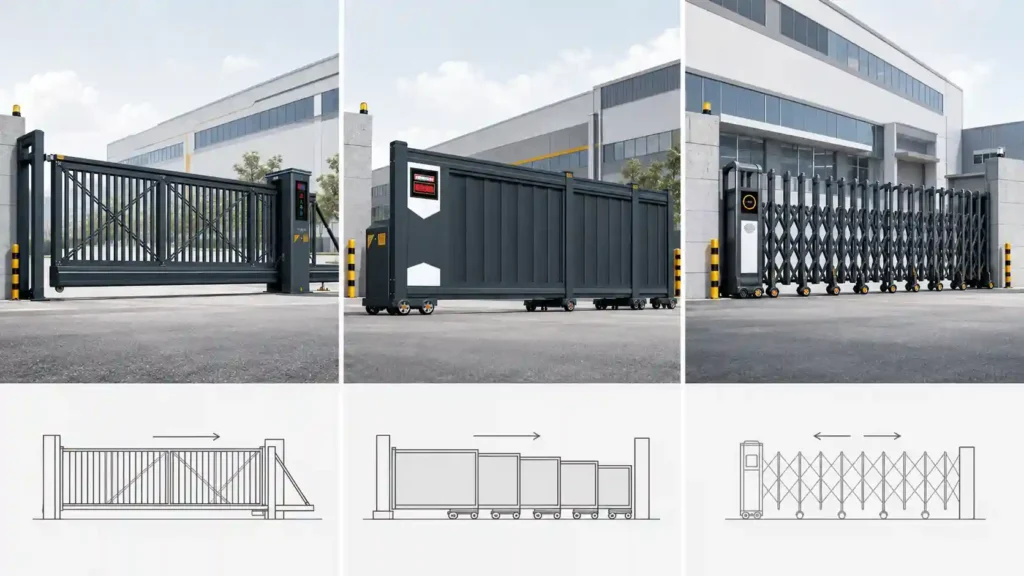
Choosing an entrance gate is not simply about appearance.
For factories, logistics centers, residential communities, commercial buildings and public facilities, the right gate depends on several practical factors:
- available side space
- driveway condition
- opening width
- vehicle traffic
- security requirements
- installation environment
- maintenance expectations
- project budget
Three gate systems are particularly common for wide entrances: cantilever sliding gates, telescopic sliding gates and retractable gates.
They may look similar because all three open horizontally, but their structures and ideal applications are very different.
Quick answer:
Choose a cantilever gate when you want a clean, trackless entrance or when the driveway is uneven.
Choose a telescopic sliding gate when the entrance is wide but side run-back space is limited.
Choose a retractable gate when compact storage, flexibility and a more economical solution are the priorities.
This guide explains the differences and helps you determine which gate system is better for your project.
Cantilever vs Telescopic vs Retractable Gate: Quick Comparison
| Feature | Cantilever Sliding Gate | Telescopic Sliding Gate | Retractable Gate |
|---|---|---|---|
| Opening Method | Single suspended gate leaf slides sideways | Two or more panels slide and stack together | Accordion-style sections expand and retract |
| Ground Track | No | Depends on design | Usually guided by wheels / trackless options available |
| Side Space Required | High | Medium | Very low |
| Uneven Ground | Excellent | Moderate | Moderate |
| Structural Strength | Excellent | Excellent | Moderate |
| Wind Resistance | Excellent when correctly engineered | Very good | Depends heavily on gate structure |
| Large Entrance | Good | Excellent | Excellent |
| Opening Appearance | Clean and premium | Modern and engineered | Practical and flexible |
| Maintenance | Relatively low | Medium | Medium |
| Installation Complexity | Medium–High | High | Relatively low |
| Typical Cost | High | High | More economical |
| Best For | Industrial estates, premium entrances, uneven ground | Factories, logistics centers, wide entrances with limited side space | Schools, communities, factories and budget-sensitive projects |
Quick recommendation
Uneven ground or no ground track allowed → Cantilever Gate
Large opening + limited side space → Telescopic Sliding Gate
Limited budget + compact storage required → Retractable Gate
1. What Is a Cantilever Sliding Gate?
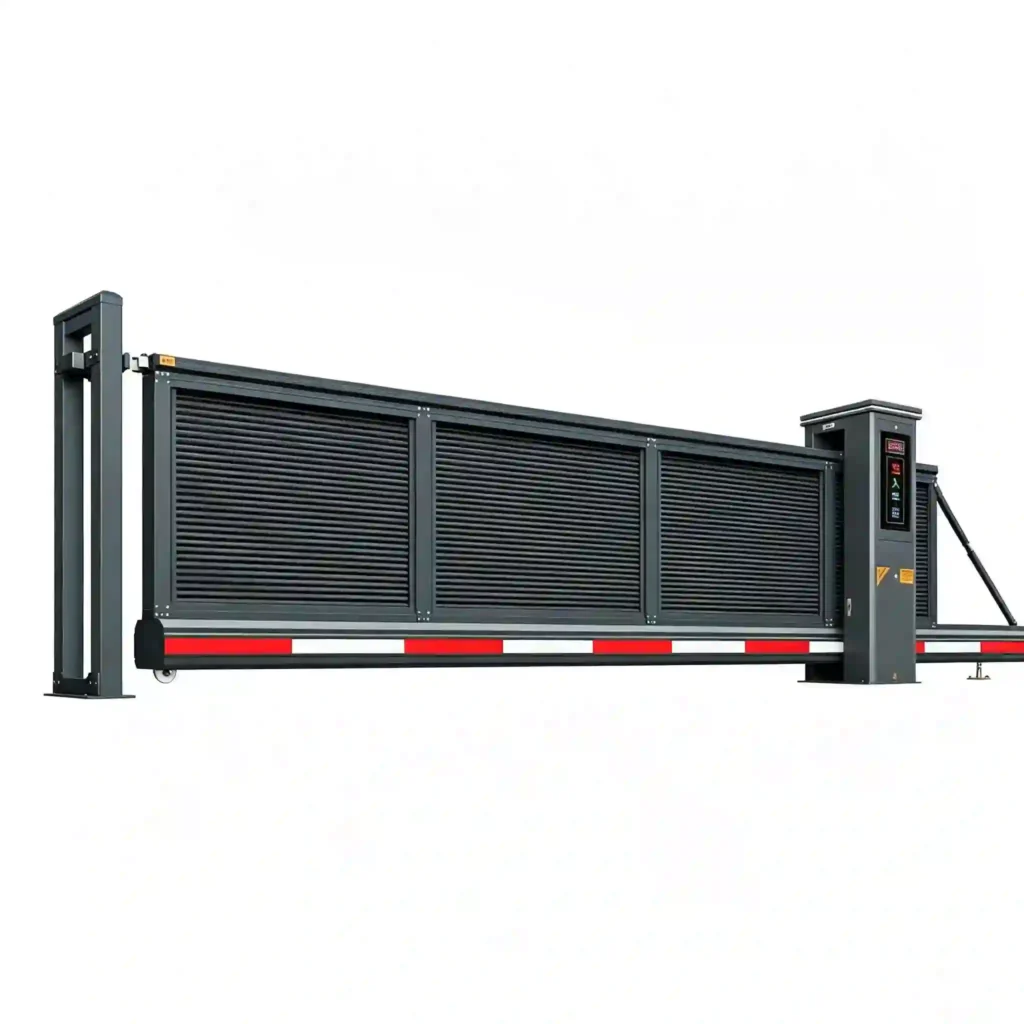
A cantilever sliding gate is a sliding gate that is suspended above the driveway instead of running directly on a ground track.
The gate is supported by a counterbalance structure and roller system installed beside the entrance. As the motor operates, the entire gate leaf moves horizontally while remaining above the ground.
Because there is no rail across the vehicle passage, the entrance remains clean and unobstructed.
This is why cantilever gates are commonly described as a trackless sliding gate solution.
Cantilever systems are particularly useful where ground tracks would be difficult to maintain because of uneven pavement, dirt, gravel, snow or debris. Industry guidance similarly identifies cantilever gates as suitable for uneven or debris-prone entrances.
Advantages of Cantilever Gates
1. No ground track across the driveway
This is the biggest advantage.
Since the gate is suspended above the entrance, you do not need to cut or install a track across the driveway.
That creates a much cleaner entrance and reduces interference with vehicle traffic.
For factories where trucks, forklifts or heavy vehicles frequently cross the entrance, this can be particularly useful.
2. Suitable for uneven ground
Traditional tracked gates require a relatively flat and properly installed rail.
A cantilever gate can operate above:
- uneven concrete
- gravel surfaces
- block paving
- slightly sloped driveways
- areas where debris frequently accumulates
This makes it one of the most adaptable industrial gate systems.
3. Strong and stable structure
Cantilever gates normally use a rigid gate frame together with a supporting counterbalance section.
The structure is therefore well suited to demanding commercial and industrial entrances.
For properly designed systems, this can provide excellent stability and wind resistance.
4. Clean architectural appearance
Because there is no track running across the driveway, the gate appears to “float” above the entrance.
That gives cantilever gates a particularly clean and premium appearance.
They are therefore often used at:
- corporate headquarters
- industrial parks
- commercial complexes
- government facilities
- premium residential developments
Disadvantages of Cantilever Gates
The biggest limitation is side space.
A cantilever gate requires not only enough room for the gate opening but also additional space for the counterbalance structure.
For example, commercial cantilever systems commonly require additional lateral space beyond the clear opening, depending on the structural design.
That means a cantilever gate may not be practical if buildings, walls or landscaping are located immediately beside the entrance.
Its structural requirements can also make the initial investment higher than a simple retractable gate.
Best Applications for Cantilever Gates
A cantilever sliding gate is usually a strong choice for:
- industrial parks
- factories
- warehouses
- logistics centers
- government facilities
- high-end commercial properties
- entrances with uneven pavement
- entrances where ground tracks are not desirable
Best choice when:
You value durability, appearance and track-free operation more than minimum initial cost.
Advantages of Telescopic Sliding Gates
1. Saves side space
This is the main reason to choose a telescopic gate.
Imagine you have a 10-meter entrance, but only around 5–6 meters of usable space beside it.
Installing a conventional single-leaf sliding gate may be impossible.
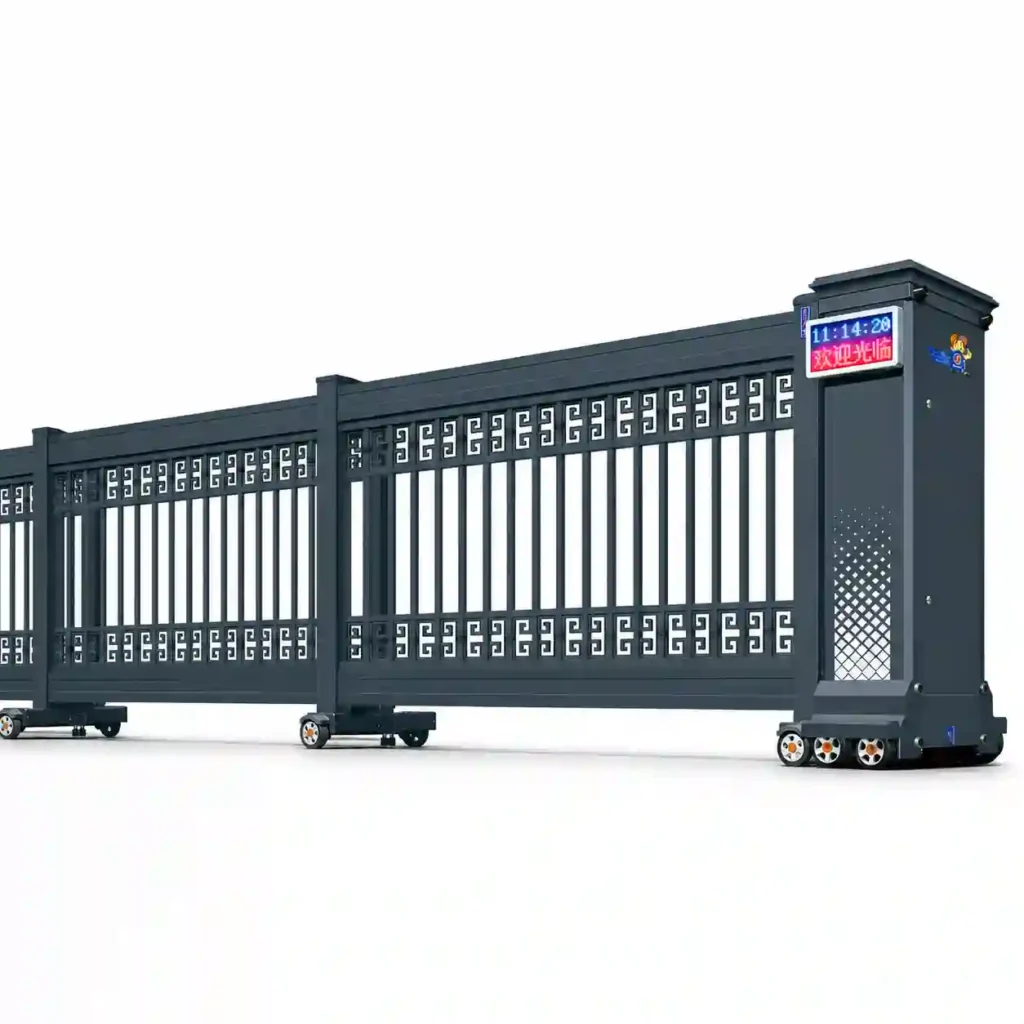
A telescopic gate divides that large gate into multiple shorter sections.
The panels then overlap when opening, significantly reducing the required run-back length.
This is why telescopic gates are often described as:
“Wide opening, limited side space.”
2. Excellent for large entrances
Telescopic systems are particularly suitable for projects where trucks or large vehicles require a wide clear opening.
Typical applications include:
- factories
- logistics centers
- distribution centers
- industrial parks
- warehouses
- commercial entrances
Some commercial telescopic gate systems are specifically engineered for large openings while reducing side clearance compared with a single sliding leaf.
3. Strong industrial appearance
Unlike accordion-style retractable gates, telescopic gates usually use large rigid gate panels.
The entrance therefore looks more substantial and architectural.
If you want an industrial entrance to look:
- clean
- modern
- secure
- premium
a telescopic sliding gate is often more suitable than a conventional retractable gate.
4. High structural stability
Because each section uses a rigid frame, a properly engineered telescopic system can provide strong resistance to deformation and wind.
This makes it suitable for entrances that require frequent operation and long-term durability.
Disadvantages of Telescopic Sliding Gates
A telescopic gate has more moving components than a simple sliding gate.
Multiple panels must remain synchronized.
Therefore:
- installation accuracy is more important
- alignment must be correct
- drive components require proper commissioning
- maintenance may be more complicated
Industry sources similarly note that telescopic systems require precise installation because of their more complicated mechanism.
The initial cost is also normally higher than a basic retractable gate.
Best Applications for Telescopic Sliding Gates
Choose a telescopic gate for:
- factory entrances
- logistics centers
- warehouse entrances
- large commercial facilities
- industrial parks
- wide driveways with limited side space
- entrances with frequent truck traffic
Best choice when:
You need a large clear opening but do not have enough lateral space for a conventional sliding or cantilever gate.
3. What Is a Retractable Gate?
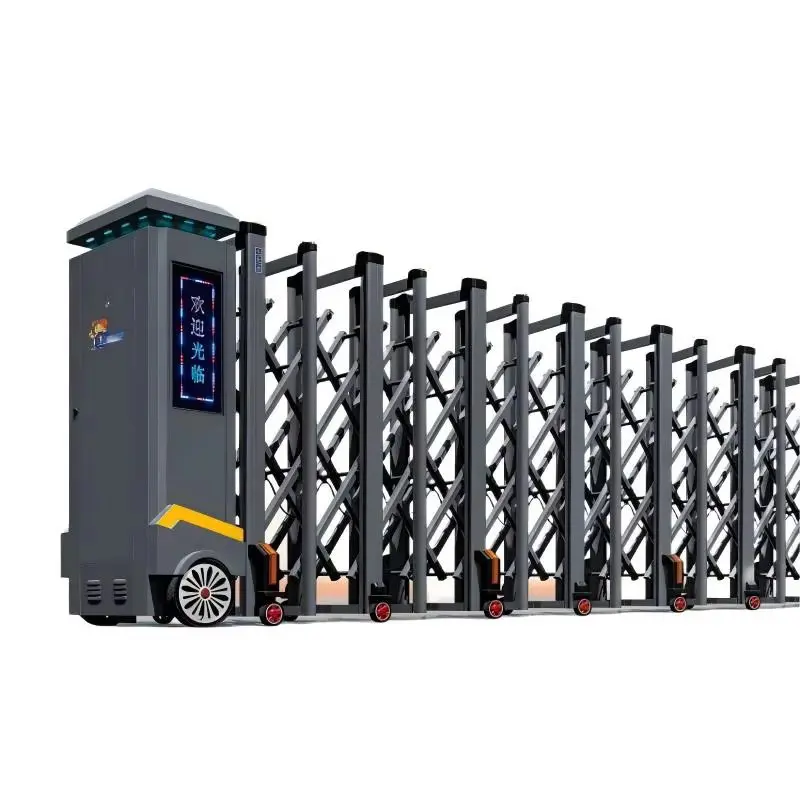
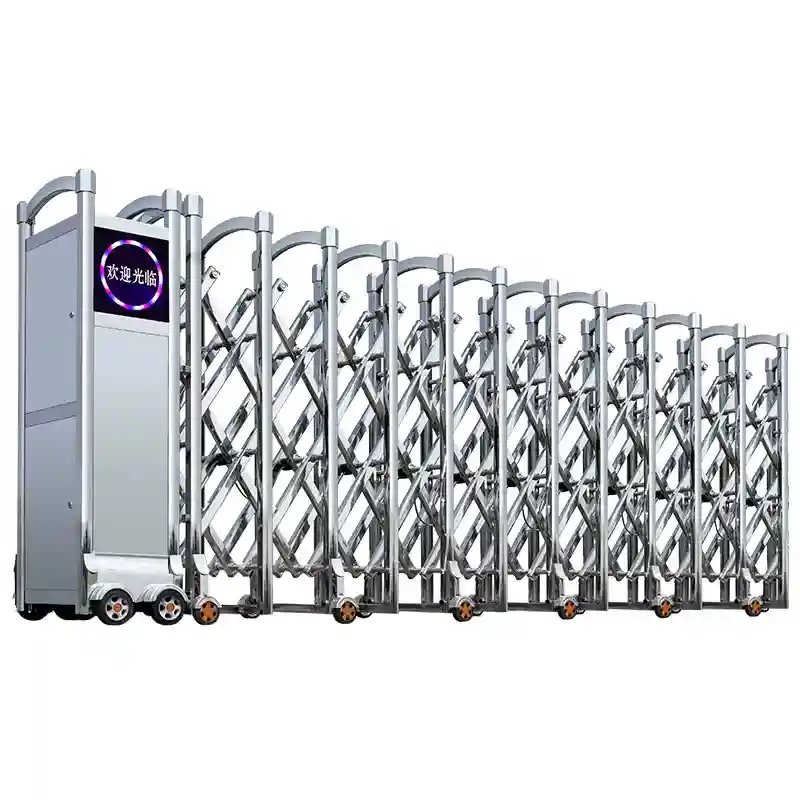
A retractable gate uses multiple linked sections connected in an accordion-like structure.
Instead of moving as one rigid panel, the entire gate expands when closing and compresses when opening.
You can think of it like an accordion:
when opened, the gate folds into a relatively compact area beside the entrance.
Retractable gates are widely used in China and many international industrial and commercial projects because they combine:
wide coverage + compact storage + relatively economical installation.
Commercial retractable gate systems are particularly useful for very wide entrances where conventional side run-back is unavailable.
Advantages of Retractable Gates
1. Very space-efficient
This is one of the biggest advantages.
A retractable gate compresses into a relatively short length once opened.
That means you do not need enough side space to store an entire rigid gate leaf.
For entrances with limited installation space, this can be extremely useful.
2. Suitable for very wide entrances
Because the structure consists of multiple connected sections, retractable gates can be manufactured for long entrance spans.
This makes them popular for:
- factories
- schools
- residential communities
- parking areas
- exhibition centers
- commercial compounds
- large facility entrances
3. More economical
Compared with heavy-duty cantilever or complex telescopic sliding systems, retractable gates can often provide a more economical entrance solution.
This makes them attractive when project budget is an important factor.
4. Mature and flexible design
Automatic retractable gates have been used for many years.
They can support different access-control methods such as:
- remote control
- push button
- RFID
- card reader
- vehicle loop detector
- license plate recognition
- smartphone or smart access systems
This makes them relatively easy to integrate into different entrance-control projects.
Disadvantages of Retractable Gates
Retractable gates also involve more joints and moving sections.
After long-term operation, these connection points and rollers may require adjustment or maintenance.
Compared with rigid cantilever or telescopic gates, retractable systems may also provide:
- lower structural rigidity
- less impact resistance
- more visible mechanical movement
- higher operational noise depending on the model
For very demanding industrial entrances with heavy truck traffic or high wind loads, a heavy-duty sliding system may therefore be preferable.
Best Applications for Retractable Gates
Retractable gates are especially suitable for:
- schools
- residential communities
- small and medium factories
- parking entrances
- commercial properties
- temporary or flexible access control
- projects with limited budgets
Best choice when:
You want maximum space efficiency at a more economical project cost.
Cantilever vs Telescopic vs Retractable Gate: Which Is Stronger?
If structural strength is one of your main concerns, the general order is:
Cantilever Gate ≈ Telescopic Sliding Gate > Retractable Gate
Both cantilever and telescopic gates normally use large rigid structural frames.
Retractable gates rely on multiple interconnected moving sections.
However, this does not mean every cantilever gate is automatically stronger.
Strength also depends on:
- aluminum or steel profile dimensions
- material thickness
- gate height
- opening width
- reinforcement design
- wind load
- wheel and roller system
- welding quality
- foundation design
Therefore, structural specifications should always be checked for each project.
Which Gate Is Better for Windy Areas?
For high-wind environments, rigid sliding structures generally provide better stability.
A properly engineered cantilever gate or telescopic sliding gate is usually the first option for demanding sites.
However, wind resistance cannot be judged from gate type alone.
A solid-panel gate creates much greater wind pressure than an open-bar gate.
For windy projects, also consider:
Gate infill
Open vertical-bar designs allow wind to pass through more easily.
Gate height
Higher gates create larger wind loads.
Gate width
Longer gate structures require stronger beams and foundations.
Local wind conditions
Coastal sites, mountain regions and exposed industrial areas require additional engineering consideration.
Which Gate Is Best for Uneven Ground?
Best option: Cantilever Sliding Gate
Because a cantilever gate does not rely on a track across the driveway, it performs particularly well where the ground is:
- uneven
- dusty
- muddy
- covered with gravel
- frequently crossed by trucks
- difficult to keep clean
If maintaining a ground rail would be difficult, the cantilever structure usually provides the most practical solution.
Which Gate Needs the Least Side Space?
Best option: Retractable Gate
A retractable gate compresses almost like an accordion.
Therefore it generally requires far less storage space than a full rigid sliding panel.
Second option: Telescopic Sliding Gate
A telescopic gate requires more space than a retractable gate but considerably less run-back than a conventional single sliding leaf.
Usually requires the most space: Cantilever Gate
Cantilever gates need additional space for the counterbalance section.
So if your site boundary is very short, always calculate lateral clearance before selecting one.
Which Gate Is Best for Heavy Truck Traffic?
For industrial entrances with:
- container trucks
- trailers
- heavy trucks
- frequent deliveries
- 24-hour vehicle access
we normally prioritize:
- structural strength
- reliability
- clear opening width
- ground condition
- opening frequency
Recommended choices
Cantilever gate: excellent where track-free operation and durability are priorities.
Telescopic gate: particularly suitable when you need a wide truck entrance but side space is limited.
A retractable gate can still be used, but for demanding heavy-industrial projects, rigid sliding structures are usually worth considering first.
Which Gate Opens Faster?
There is no universal winner because opening speed depends on:
- gate width
- motor power
- control system
- gate weight
- safety requirements
However, telescopic systems can sometimes achieve efficient opening because multiple panels move simultaneously rather than requiring one long gate leaf to travel the entire opening distance.
Some telescopic systems specifically use synchronized panels moving at different speeds to reach their final positions together.
For a high-traffic entrance, ask the supplier for:
complete opening time, rather than only motor speed.
Don’t Choose a Gate by Price Alone
One common mistake is comparing only the initial purchase price.
A better comparison is:
Total Cost of Ownership = Gate Cost + Installation + Civil Work + Maintenance + Downtime
For example:
A cheaper gate that repeatedly suffers from track blockage at a dusty industrial entrance may ultimately cost more to maintain.
On the other hand, installing an expensive cantilever gate at a small residential entrance may be unnecessary.
The best gate is therefore not necessarily the most expensive one.
It is the gate whose structure matches the site.
7 Questions to Ask Before Choosing an Entrance Gate
Before contacting a gate supplier, collect these seven pieces of information.
1. What is the clear opening width?
Measure the actual vehicle passage width.
For example:
6 m / 8 m / 10 m / 15 m / 20 m
2. How much side space is available?
This is one of the most important measurements.
Measure from the edge of the clear opening to the nearest:
- wall
- building
- fence
- landscaping
- equipment
3. Is the driveway level?
Check whether the ground is:
- concrete
- asphalt
- gravel
- sloped
- uneven
4. What vehicles will use the gate?
For example:
- passenger cars
- delivery vans
- forklifts
- container trucks
- trailers
5. How frequently will the gate operate?
A residential gate opening 20 times per day has completely different requirements from a logistics center opening hundreds of times per day.
6. What access control system is required?
Possible integrations include:
- remote controls
- RFID
- keypad
- card reader
- vehicle loop detector
- license plate recognition
- intercom
- BMS
- mobile access
7. What is the local environment?
Tell the supplier whether the gate will be installed in:
- coastal environments
- high-humidity regions
- snow regions
- dusty industrial sites
- high-wind areas
These conditions influence material, motor and structural design.
Recommended Gate by Application
| Application | Recommended Gate | Why |
|---|---|---|
| Factory Entrance | Cantilever / Telescopic | Strong, reliable and suitable for frequent vehicle access |
| Logistics Center | Telescopic Gate | Wide opening with reduced side run-back |
| Uneven Driveway | Cantilever Gate | No ground track required |
| School | Retractable Gate | Practical and economical |
| Residential Community | Retractable / Telescopic | Depends on budget and appearance requirements |
| Premium Commercial Entrance | Cantilever Gate | Clean appearance and robust structure |
| Limited Side Space | Telescopic / Retractable | Reduced storage area |
| Very Wide Entrance | Telescopic / Retractable | Flexible large-span configuration |
| Heavy Truck Entrance | Cantilever / Telescopic | Strong rigid structure |
| Budget-Conscious Project | Retractable Gate | Lower entry cost and flexible installation |
How to Choose in 30 Seconds
Choose a Cantilever Gate if:
You want no ground track, strong construction and reliable operation on uneven ground.
Choose a Telescopic Sliding Gate if:
You have a wide entrance but limited side run-back space.
Choose a Retractable Gate if:
You want compact storage, flexible installation and a more economical entrance solution.
Can These Gates Be Connected to License Plate Recognition?
Yes.
All three automatic gate types can potentially be integrated with access-control systems.
A typical factory entrance may use:
Vehicle arrives → Camera reads license plate → Access controller verifies vehicle → Gate opens → Vehicle loop confirms passage → Gate closes
Other systems may include:
- RFID readers
- card readers
- remote controls
- push buttons
- intercom systems
- infrared sensors
- safety photocells
- vehicle loop detectors
For industrial entrances, the gate should therefore be considered as part of a complete entrance access-control system, not just as an isolated product.
Final Recommendation
There is no single gate that is best for every entrance.
The most appropriate choice depends on the relationship between opening width, available side space, ground conditions, traffic frequency and budget.
In simple terms:
Choose a cantilever gate for uneven ground, track-free operation and premium industrial entrances.
Choose a telescopic sliding gate for large openings where lateral space is limited.
Choose a retractable gate when compact storage and project economy are the priority.
For commercial and industrial projects, provide your supplier with the clear opening width, available side space, gate height, site photos and vehicle type before requesting a final recommendation.
This makes it much easier to determine the correct gate structure, motor configuration and safety system.
Frequently Asked Questions
What is the main difference between a cantilever gate and a telescopic gate?
A cantilever gate normally uses one rigid gate structure suspended above the driveway, while a telescopic gate uses multiple overlapping panels to reduce the side space required for opening.
Which gate is best for uneven ground?
A cantilever gate is usually the best option because it does not require a ground track across the driveway.
Which gate saves the most side space?
A retractable gate generally requires the least storage space because its accordion structure compresses when opened. A telescopic gate is another good option where a rigid gate structure is preferred.
Are telescopic gates suitable for factories?
Yes. Telescopic sliding gates are particularly suitable for factories, warehouses and logistics centers that need a wide vehicle entrance but have limited side run-back space.
Are retractable gates suitable for industrial entrances?
Yes. Retractable gates are widely used at factories and commercial facilities. For very high traffic, high wind loads or demanding heavy-industrial sites, however, a rigid cantilever or telescopic system may provide greater structural stability.
Can these gates be automated?
Yes. Cantilever, telescopic and retractable gates can all be configured with automatic gate operators and access-control devices.
Which gate is more expensive?
It depends on the gate dimensions, material, motor and project requirements, but cantilever and telescopic systems generally involve more structural engineering than basic retractable gates.
Can these gates work with license plate recognition?
Yes. Automatic versions can be integrated with license plate recognition, RFID, card readers, remote controls and other access-control systems.