Types of Turnstile Gates: Differences and How to Choose the Right One
Choosing the right pedestrian access gate is not simply a matter of selecting the best-looking model.
Different turnstile gate types provide different levels of security, pedestrian flow, passage width, accessibility, appearance, weather resistance, and access control capability.
A tripod turnstile may be ideal for a factory employee entrance, while a speed gate may be more suitable for a premium office lobby. A swing barrier is often preferred when wheelchairs, luggage, or carts need to pass, while a full-height turnstile is generally selected when stronger physical access control is required.
Understanding these differences can help you choose the right pedestrian turnstile gate for your project.
Quick Answer: What Are the Main Types of Turnstile Gates?
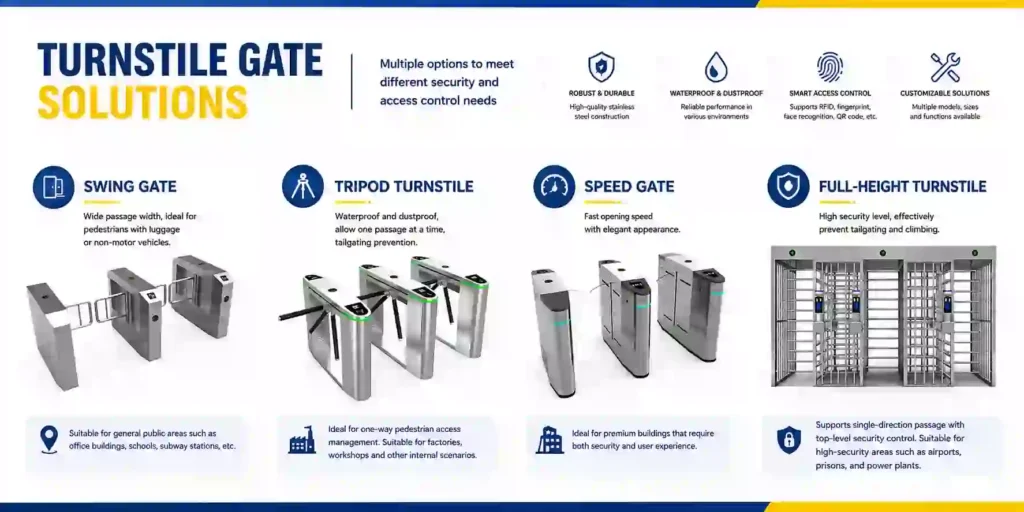
The six most common types of turnstile gates are tripod turnstiles, swing barrier gates, flap barrier gates, speed gates, sliding turnstiles, and full-height turnstiles.
Each type is designed for a different combination of security, traffic flow, passage width, accessibility, appearance, and installation environment.
In general, tripod turnstiles are economical and durable, swing gates provide flexible and wider passages, flap barriers support efficient pedestrian flow, speed gates combine high traffic capacity with a premium appearance, sliding turnstiles provide compact barrier movement, and full-height turnstiles provide stronger physical access control. Similar distinctions are commonly used in current industry selection guides.
Turnstile Gate Types Comparison
| Turnstile Type | Security Level | Pedestrian Flow | Wide Passage | Appearance | Typical Applications |
|---|---|---|---|---|---|
| Tripod Turnstile | Medium | Medium | Limited | Functional | Factory, gym, school, construction site |
| Swing Barrier Gate | Medium–High | Medium–High | Excellent | Modern | Office, hospital, community, accessible lane |
| Flap Barrier Gate | Medium–High | High | Model dependent | Modern | Metro, office, commercial building |
| Speed Gate | Medium–High | High | Available | Premium | Office lobby, airport, corporate campus |
| Sliding Turnstile | Medium–High | High | Model dependent | Premium | Office, government, residential building |
| Full-Height Turnstile | High | Medium | Separate lane usually required | Industrial | Factory perimeter, stadium, construction site |
Important: There is no single turnstile type that is best for every project. Actual performance depends on the selected model, barrier height, sensors, control logic, access control device, installation environment, and overall entrance design.
1. Tripod Turnstile
A tripod turnstile uses three rotating arms to control pedestrian passage.
After a user successfully presents a card, QR code, ticket, fingerprint, or other authorized credential, the mechanism allows the user to push the arm forward and pass through.
Tripod turnstiles are one of the most traditional pedestrian access control solutions.
Their relatively simple structure, compact footprint, and cost efficiency make them especially popular for employee entrances and locations where the main purpose is controlling one-person-at-a-time passage.
Where Are Tripod Turnstiles Commonly Used?
Tripod turnstiles are commonly used at:
Factories, construction sites, schools, gyms, employee entrances, swimming pools, visitor entrances, and some ticketed facilities.
They are particularly practical when a project needs reliable access control without the higher cost of an optical speed gate.
Main Advantages
Tripod turnstiles are usually durable, economical, compact, and relatively easy to maintain.
They can also integrate with common access control systems such as RFID card readers, QR scanners, facial recognition terminals, fingerprint readers, and ticketing systems.
Main Limitation
The biggest limitation is passage accessibility.
Because the rotating arms occupy the passage, tripod turnstiles are usually not the best choice for wheelchairs, large luggage, strollers, or carts.
For these projects, an additional swing barrier gate or accessible pedestrian lane is often required. Industry selection guides make the same distinction between tripod lanes and wider accessible swing-gate lanes.
2. Swing Barrier Gate
A swing barrier gate, also called a swing turnstile or swing gate turnstile, uses one or two panels that rotate around a vertical axis.
After authorization, the panels swing open and allow the pedestrian to pass.
The gate then automatically returns to the closed position.
One of the main advantages of a swing gate is its flexible passage width.
This makes it one of the most practical turnstile solutions for locations that need to accommodate wheelchairs, luggage, strollers, trolleys, or other wide objects.
Where Are Swing Barrier Gates Commonly Used?
Swing gates are suitable for:
Office buildings, hospitals, residential communities, factories, schools, commercial buildings, supermarkets, reception areas, and accessible entrances.
Why Choose a Swing Gate?
Compared with a tripod turnstile, a swing barrier provides a more comfortable and open passage.
Compared with many flap barriers, it also offers greater flexibility when a wide lane is required.
Modern swing gates can use infrared sensors to monitor pedestrian movement and provide anti-pinch protection.
They can also be integrated with:
RFID cards, facial recognition, QR codes, fingerprints, visitor systems, and other access control devices.
Tripod vs Swing Turnstile: Which Is Better?
Choose a tripod turnstile when budget, durability, and controlled one-person passage are the main priorities.
Choose a swing turnstile when passage width, user comfort, wheelchair access, or luggage access is more important.
For many commercial and public buildings, a combination of standard lanes and one wide swing-gate lane provides a practical solution.
3. Flap Barrier Gate
A flap barrier gate uses retractable wing-shaped panels installed inside the turnstile cabinets.
After successful authentication, the panels retract into the cabinet and open the passage.
After the pedestrian passes, the panels return to the closed position.
Compared with tripod turnstiles, flap barriers provide a more modern appearance and do not require users to physically push an arm.
They also commonly use multiple infrared sensors to monitor pedestrian movement.
Where Are Flap Barriers Commonly Used?
Flap barriers are frequently used in:
Metro stations, railway stations, office buildings, commercial buildings, corporate campuses, libraries, and indoor access control areas.
Advantages of Flap Barrier Gates
Flap barriers provide relatively fast pedestrian access, compact barrier movement, modern appearance, and good integration with ticketing and access control systems.
They are therefore commonly selected for locations with medium-to-high pedestrian traffic.
Swing Gate vs Flap Barrier
A swing gate is generally more flexible when a wider passage is required.
A flap barrier is often selected when compact operation and faster pedestrian processing are more important.
The final choice should depend on passage width, user groups, traffic level, sensor requirements, and building design.
4. Speed Gate
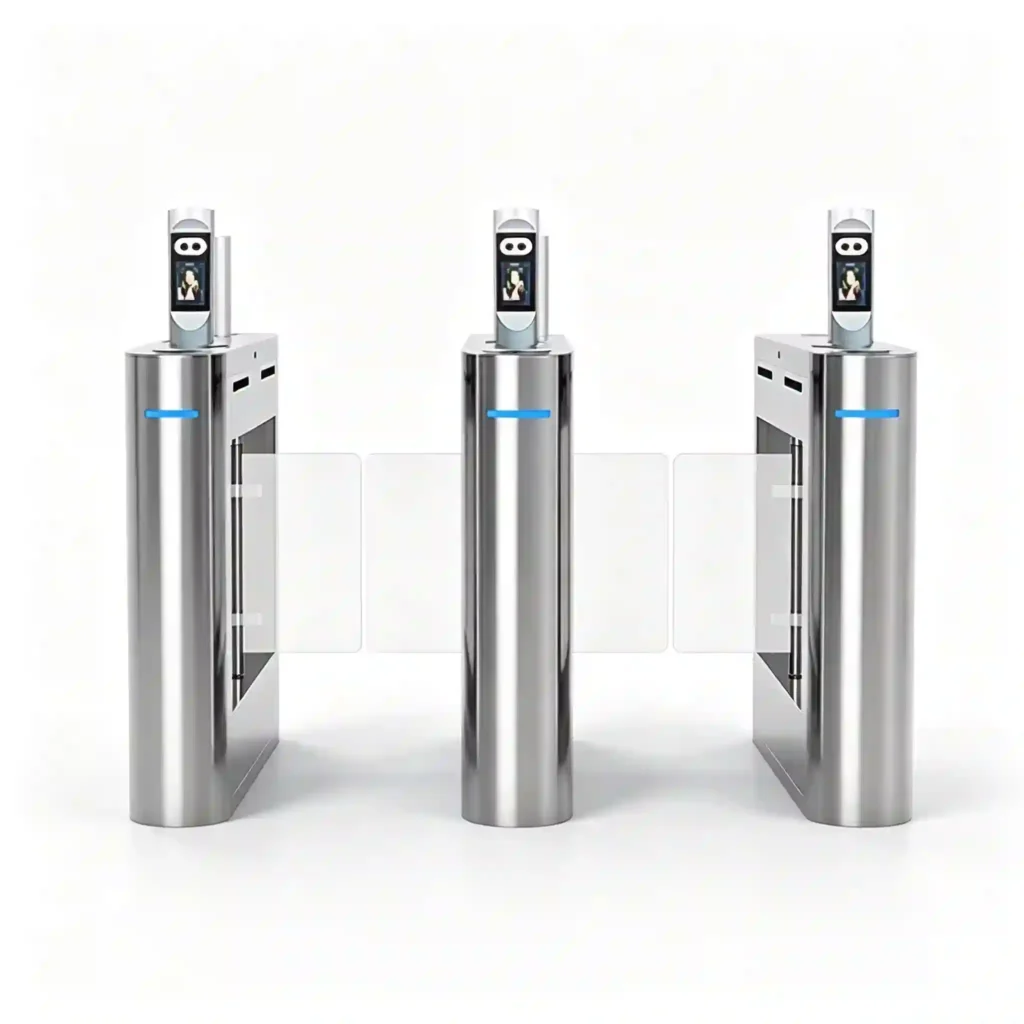
A speed gate is a modern optical pedestrian access gate that combines motor-driven barrier panels with infrared or optical detection sensors.
Depending on the model, the panels may swing outward or retract into the cabinet.
Speed gates are usually designed for smooth, fast, and relatively contactless pedestrian passage.
This makes them particularly suitable for high-traffic buildings where both efficiency and appearance are important.
Where Are Speed Gates Commonly Used?
Typical applications include:
Corporate headquarters, premium office buildings, airports, government facilities, universities, smart campuses, financial buildings, and premium residential developments.
Why Choose a Speed Gate?
The main advantages include:
High pedestrian flow, modern appearance, multiple sensor zones, contactless operation, and flexible access control integration.
They can usually work with:
Employee cards, QR codes, visitor systems, facial recognition, biometric devices, and compatible access management software.
Current comparison guides generally position speed gates toward the high-throughput and premium end of pedestrian gate systems.
Flap Barrier vs Speed Gate
A flap barrier is usually a practical option for efficient indoor pedestrian management.
A speed gate is often chosen when the project places greater emphasis on premium design, faster user experience, and advanced pedestrian detection.
However, the exact difference depends heavily on the product design because the term “speed gate” describes a broader class of optical turnstile systems rather than one single barrier shape.
5. Sliding Turnstile
A sliding turnstile uses glass or acrylic panels that move horizontally to open and close the passage.
Unlike a swing gate, the panels do not require a large outward movement arc.
This creates a clean and relatively enclosed entrance appearance.
Sliding gates are often selected for modern buildings where appearance, controlled access, and compact panel movement are important.
Typical Applications
Sliding turnstiles are commonly considered for:
Modern office buildings, government facilities, hospitals, residential buildings, commercial buildings, and indoor security checkpoints.
Advantages
Compared with a basic tripod turnstile, a sliding gate provides a stronger visual barrier and more modern appearance.
It can also integrate with infrared sensors, biometric devices, card readers, and visitor management systems.
What Should Buyers Consider?
Passage width, glass panel height, internal drive structure, installation space, maintenance access, and indoor/outdoor suitability should all be confirmed before purchasing.
Different sliding turnstile designs can vary significantly.
6. Full-Height Turnstile
A full-height turnstile uses a floor-to-ceiling rotating structure to control pedestrian access.
Unlike waist-height gates, users cannot simply step over the barrier.
For this reason, full-height turnstiles are generally selected for projects where physical perimeter security is more important than premium appearance.
Where Are Full-Height Turnstiles Used?
Typical applications include:
Industrial plants, construction sites, stadiums, warehouses, infrastructure facilities, outdoor employee entrances, and high-security perimeter areas.
Main Advantages
A full-height turnstile provides strong physical access control and controlled one-person passage.
It can be integrated with:
RFID cards, QR codes, ticket systems, biometric recognition, and employee access control systems.
Main Limitations
Full-height turnstiles require more installation space and usually provide slower passage than optical speed gates.
They are also generally unsuitable as the only accessible route for wheelchairs, large luggage, or emergency evacuation.
Therefore, a separate accessible and emergency passage should normally be included according to applicable local requirements.
Among the common turnstile types, full-height models are generally positioned as the strongest physical perimeter-control option.
Tripod vs Swing vs Flap vs Speed Gate: What Is the Difference?
For many buyers, these four are the most difficult turnstile types to compare.
The easiest way to understand them is to identify the project priority.
| Main Requirement | Recommended Type |
|---|---|
| Lower budget | Tripod Turnstile |
| Factory employee access | Tripod / Full-Height |
| Wheelchair or wide passage | Swing Barrier |
| Luggage and trolley access | Swing Barrier |
| High pedestrian traffic | Speed Gate / Flap Barrier |
| Premium office appearance | Speed Gate |
| Metro or ticketing entrance | Flap Barrier / Speed Gate |
| Strong perimeter security | Full-Height Turnstile |
| Modern enclosed appearance | Sliding / Speed Gate |
The correct solution may also combine several types.
For example, a factory can install several tripod turnstiles for normal employees and one swing gate for visitors, wheelchairs, luggage, or equipment.
How to Choose the Right Turnstile Gate
The best way to select a turnstile is not to start with the product appearance.
Start with the entrance requirements.
Several current turnstile selection guides similarly emphasize security, peak traffic, available space, accessibility, installation environment, and system integration rather than selecting by appearance alone.
1. Consider the Required Security Level
Ask:
How important is preventing unauthorized entry?
For basic employee attendance and access management, a tripod or swing gate may be sufficient.
For areas requiring stronger perimeter control, a full-height turnstile may be more appropriate.
For modern buildings requiring pedestrian detection and anti-tailgating functions, optical speed gates, flap barriers, or sensor-equipped swing gates may be considered.
Remember that overall security depends not only on the barrier itself but also on sensor configuration, barrier height, software, access credentials, surveillance, and entrance layout.
2. Estimate Peak Pedestrian Traffic
Do not only consider average traffic.
Consider the busiest period of the day.
For example, factory shift changes, office morning rush hours, school entry periods, stadium events, and metro stations may experience large numbers of users within a short period.
When traffic is high, speed gates and flap barriers are often preferred because they are designed for efficient pedestrian processing.
For lower or medium traffic environments, tripod and swing gates can be sufficient.
3. Determine the Required Passage Width
Passage width is one of the most important factors when selecting a pedestrian gate.
A normal employee lane does not have the same requirement as an accessible passage.
If users may include:
Wheelchair users, people with luggage, parents with strollers, delivery carts, maintenance equipment, or large objects,
a wider passage should be planned.
Swing gates are commonly used for these wider lanes.
Always verify the final clear passage width against local accessibility and building requirements.
4. Consider Indoor or Outdoor Installation
Not every turnstile is suitable for outdoor installation.
For outdoor projects, buyers should confirm:
Weather resistance, cabinet material, waterproofing, drainage, operating temperature, corrosion resistance, and protection of electronic components.
Full-height turnstiles and selected tripod gates are commonly used outdoors, while many speed gates, flap barriers, and sliding gates are designed primarily for indoor or protected environments unless an outdoor-rated model is specified.
5. Consider Accessibility
Accessibility should be planned from the beginning of the project.
A turnstile system may need to accommodate:
Wheelchairs, elderly users, luggage, children, strollers, and carts.
Swing barrier gates are often used to create a wider accessible lane.
However, the required dimensions and emergency access arrangements should always follow the regulations applicable to the project location.
6. Consider Access Control Integration
The turnstile is only one part of an access control system.
Before purchasing, confirm what authentication method will be used.
Common options include:
RFID cards, facial recognition, fingerprint recognition, QR codes, tickets, mobile credentials, visitor management systems, and license or employee management software.
The communication interface between the access device and turnstile controller should be confirmed before production.
7. Consider Emergency Operation
Ask an important question before purchasing:
What happens if there is a fire alarm or power failure?
Depending on the project, the turnstile may need to:
Unlock, automatically open, drop an arm, connect with a fire alarm system, or operate with backup power.
Emergency behavior should be considered during the design stage rather than after installation.
8. Consider Maintenance Requirements
Different turnstile types have different maintenance requirements.
Tripod and full-height turnstiles rely heavily on mechanical rotation and locking mechanisms.
Swing gates require inspection of motors, pivots, and safety sensors.
Flap barriers and speed gates typically use more infrared sensors and motorized components.
Sliding turnstiles require proper panel alignment and drive-system maintenance.
For long-term projects, the availability of spare parts and technical support should also be considered.
Which Turnstile Gate Is Best for Different Applications?
Best Turnstile for a Factory Entrance
For factory employee entrances, tripod turnstiles are often a practical choice because they provide reliable personnel access control and can integrate with employee attendance systems.
For factories requiring stronger perimeter protection, a full-height turnstile may be more suitable.
A swing barrier gate can be added as a wider lane for visitors or equipment.
Best Turnstile for an Office Building
For modern office buildings, speed gates, swing barrier gates, or flap barriers are common choices.
Speed gates are especially suitable where the entrance appearance and pedestrian experience are important.
Best Turnstile for a Hospital
Hospitals usually require wider and more comfortable passages.
A swing barrier gate is often suitable because it can accommodate wheelchairs, patients, luggage, and medical equipment more easily than a tripod turnstile.
Best Turnstile for a Metro or Railway Station
For high passenger flow and ticket verification, flap barriers and speed gates are commonly considered.
Their automatic operation and sensor systems are suitable for frequent pedestrian access.
Best Turnstile for a Construction Site
Tripod and full-height turnstiles are common choices.
A tripod gate provides economical employee attendance control, while a full-height turnstile can provide stronger perimeter access control.
Best Turnstile for a Premium Commercial Building
For high-end corporate lobbies, financial buildings, premium residential developments, and smart campuses, speed gates are often selected because they combine access control with a modern architectural appearance.
A Simple Turnstile Selection Guide
If your main requirement is low cost, consider a tripod turnstile.
If you need wheelchair or luggage access, consider a swing barrier gate.
If you need fast pedestrian flow, consider a flap barrier or speed gate.
If you need a premium entrance appearance, consider a speed gate or sliding turnstile.
If you need strong physical perimeter security, consider a full-height turnstile.
If you are still unsure, provide your entrance width, expected pedestrian traffic, installation environment, access control method, and required security level to the supplier before selecting a model.
Frequently Asked Questions About Turnstile Gate Types
What are the most common types of turnstile gates?
The most common pedestrian turnstile types include tripod turnstiles, swing barrier gates, flap barriers, speed gates, sliding turnstiles, and full-height turnstiles.
They mainly differ in barrier structure, security level, pedestrian flow, passage width, appearance, and installation environment.
Which turnstile gate is best for high pedestrian traffic?
Speed gates and flap barriers are commonly selected for high-traffic entrances because they provide fast automatic passage and can use optical sensors to monitor pedestrian movement.
Actual throughput depends on lane quantity, credential verification speed, gate configuration, and user behavior.
Which turnstile is best for wheelchair access?
Swing barrier gates are commonly used for accessible wide lanes because their passage width can be configured for wheelchairs, luggage, and carts.
The final lane width must comply with applicable local requirements.
What is the difference between a tripod turnstile and a swing gate?
A tripod turnstile uses three rotating arms and is usually more economical and compact.
A swing gate uses rotating panels and can provide a wider and more comfortable passage.
Tripod gates are common for employee access, while swing gates are often used where accessibility and wider passage are important.
What is the difference between a flap barrier and a speed gate?
Both can provide fast automated pedestrian access.
Flap barriers generally use retractable wing-shaped panels, while speed gates may use swinging or retractable panels combined with optical sensors.
Speed gates are often positioned toward premium commercial entrances, while flap barriers are widely used in transport and commercial access applications.
Which turnstile provides the highest security?
Among common pedestrian turnstile types, a full-height turnstile generally provides the strongest physical barrier.
However, the overall security level also depends on access control credentials, sensors, surveillance, fencing, alarms, and system configuration.
Can turnstile gates work with facial recognition?
Yes.
Most modern automatic turnstiles can be integrated with compatible facial recognition terminals, RFID card readers, QR code scanners, fingerprint devices, ticket systems, and other access control equipment.
The communication interface should be confirmed before installation.
Can turnstile gates be installed outdoors?
Some can, but not all turnstiles are designed for exposed outdoor environments.
Before outdoor installation, confirm the selected model’s weather protection, materials, corrosion resistance, drainage, sealing, and operating-temperature requirements.
Conclusion: Which Turnstile Gate Should You Choose?
There is no single best turnstile gate for every entrance.
The right choice depends on your project’s security level, pedestrian traffic, passage width, accessibility requirements, installation environment, access control method, appearance, and budget.
For economical employee access, a tripod turnstile may be sufficient.
For wide and accessible passages, a swing barrier is often more suitable.
For high pedestrian traffic, flap barriers and speed gates can provide efficient automated access.
For modern commercial entrances, speed gates and sliding turnstiles provide a more premium appearance.
For high-security perimeter control, full-height turnstiles provide a stronger physical barrier.
Before selecting a turnstile gate, define your project requirements first and then compare the appropriate gate configuration.
Need help choosing the right turnstile gate?
Explore our Turnstile Gate Solutions or send us your entrance width, number of lanes, expected pedestrian flow, installation environment, and access control requirements. We can recommend a suitable pedestrian access control solution for your project.